

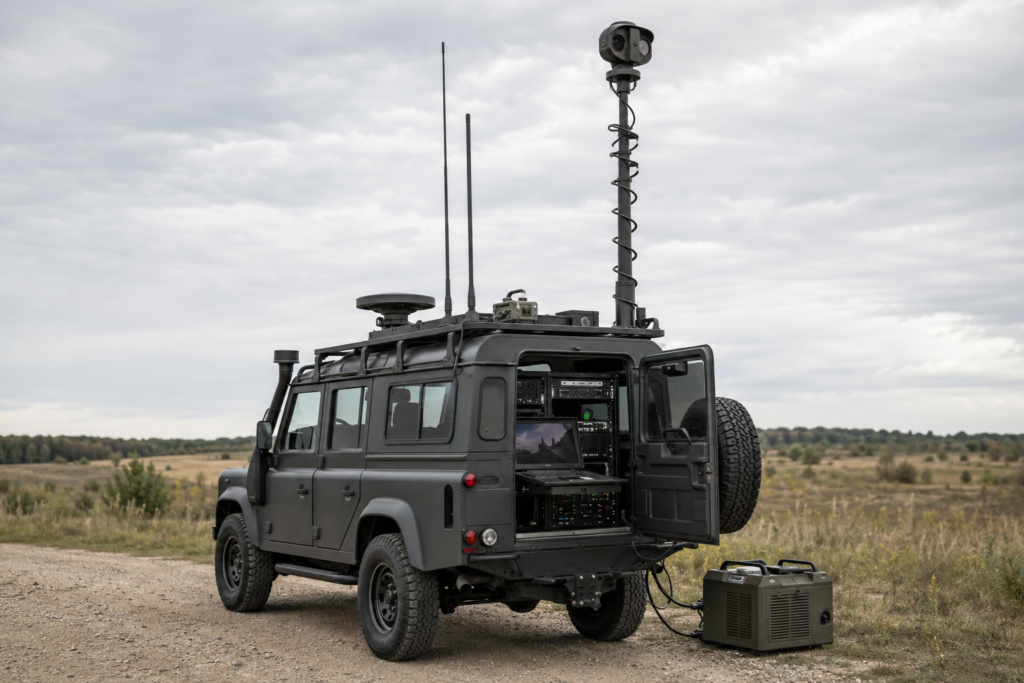
Professional Vehicle-Mounted Systems integrate surveillance sensors, communication equipment, power units and other specialized technologies onto mobile platforms. Modular designs enable standard or special-purpose vehicles to be adapted for monitoring, communications, emergency response, technical support and field operations.
Depending on operational requirements, systems can incorporate EO/IR cameras, thermal imagers, radar, radio-frequency detectors, communication terminals, data links and navigation equipment. Sensors and antennas may be installed on vehicle roofs, telescopic masts, stabilized platforms or rapidly deployable external mounts.
Integrated operator workstations provide centralized access to live video, sensor information, maps, communications and equipment status. Onboard recording, data processing and command software can support real-time monitoring, event management and information sharing with other vehicles or remote control centres.
Power can be supplied through the vehicle electrical system, auxiliary batteries, generators, solar modules or external connections. Power-distribution, conditioning and backup systems help protect sensitive equipment and maintain continuous operation during extended deployment.
Typical systems and capabilities include:
- Vehicle-mounted EO/IR surveillance systems
- Thermal and low-light imaging equipment
- Radar and airspace-monitoring sensors
- RF detection and direction-finding systems
- Radio, cellular and satellite communications
- Video and data-transmission equipment
- Telescopic masts and stabilized platforms
- Integrated antennas and navigation equipment
- Operator consoles and multi-screen workstations
- Real-time recording and data management
- Auxiliary and backup power systems
- Scene lighting and portable power distribution
- Equipment racks and secure storage
- Remote command-centre connectivity
- Modular and rapidly removable equipment packages
Vehicle-mounted solutions can be customized according to vehicle type, available payload, mission requirements, operating duration, terrain and communication architecture. Vehicle homologation, axle loads, mounting strength, electromagnetic compatibility, electrical safety and equipment restraint should be verified for the intended market and application.