

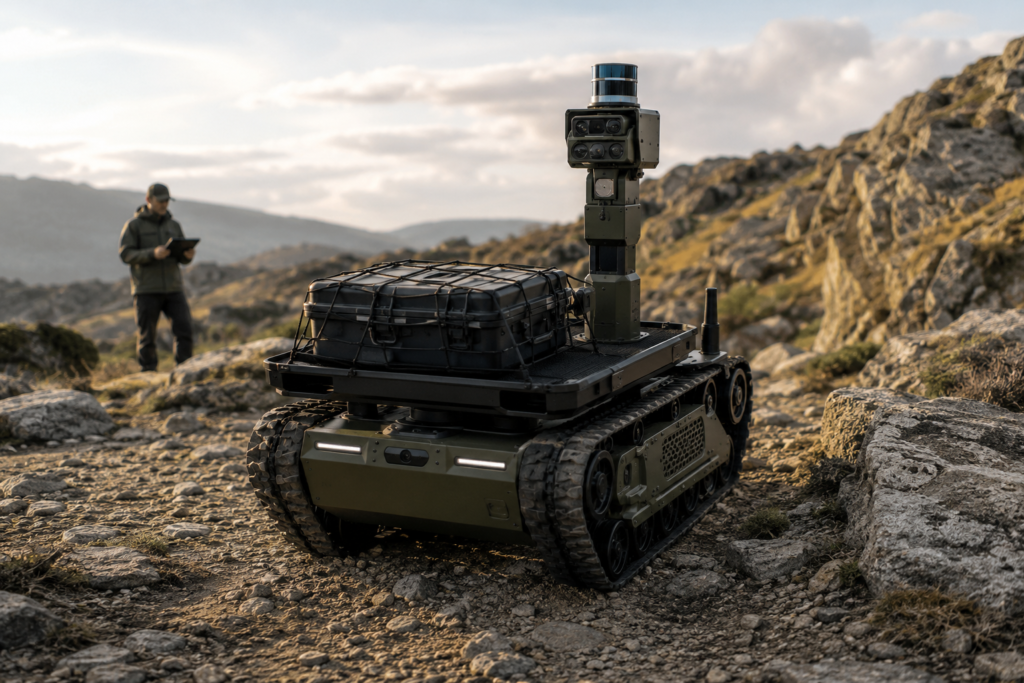
Unmanned Ground Vehicles (UGVs) are rugged robotic platforms designed to perform remote or autonomous operations in environments that may be difficult, hazardous or inaccessible to personnel. Built for high mobility and reliable operation across complex terrain, UGVs can support inspection, transportation, surveillance, emergency response and other specialized ground missions.
Depending on operational requirements, UGVs can use wheeled, tracked or hybrid mobility platforms and can be configured for indoor, outdoor and all-terrain environments. Advanced navigation, obstacle detection, positioning and remote-control technologies enable precise movement through industrial facilities, rough terrain, confined areas and other challenging operating conditions.
UGVs can be integrated with a wide range of mission equipment, including high-resolution cameras, EO/IR and thermal imaging systems, LiDAR, environmental sensors, gas detectors, robotic arms, communication modules, cargo platforms and other specialized payloads. Real-time video and sensor data can be transmitted to operators through remote control or command-and-control systems, reducing the need for personnel to enter hazardous areas.
Typical applications include:
- Industrial inspection and monitoring
- Hazardous-area reconnaissance
- Border and perimeter patrol
- Critical infrastructure inspection
- Search and rescue operations
- Emergency and disaster response
- Fire and hazardous-material incident support
- Gas and environmental detection
- Remote material and equipment transportation
- Warehouse and facility operations
- Tunnel, mine and underground inspection
- Security and remote observation
- Communication relay
- Specialized robotic operations
Available in different sizes, mobility configurations, payload capacities and control architectures, UGV platforms can be customized with mission-specific sensors, robotic equipment and communication systems to meet diverse industrial, public-safety, emergency-response and security requirements.