

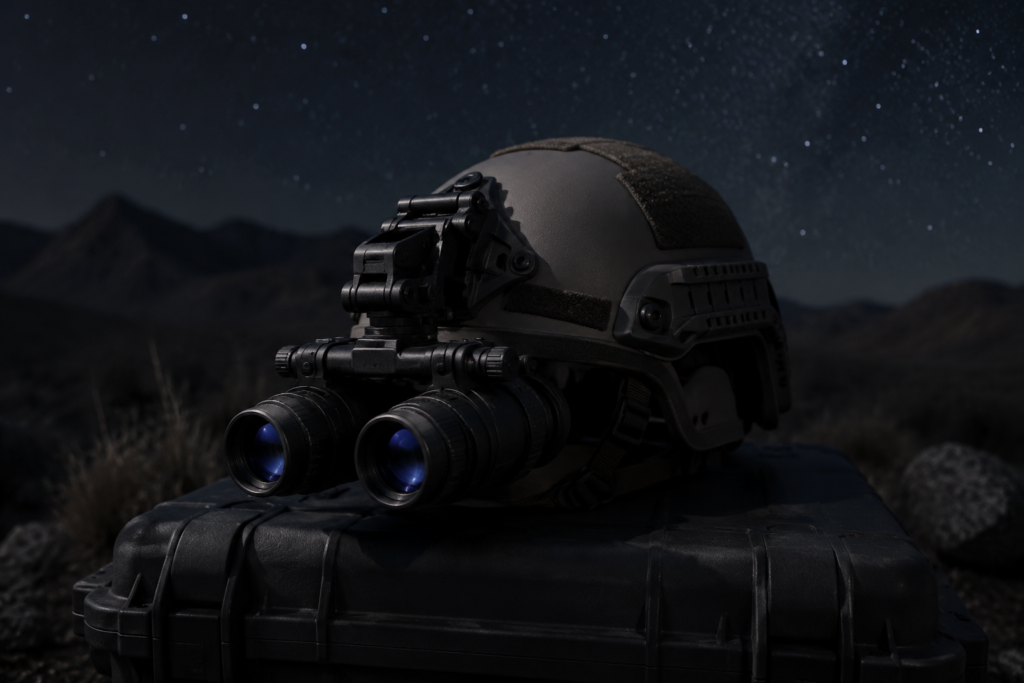
Night Vision Goggles are helmet- or head-mounted optical systems designed to provide hands-free observation, navigation and enhanced situational awareness in low-light and nighttime environments. By amplifying available ambient light or using digital night-vision technology with infrared illumination, they enable users to move and operate more effectively when normal visibility is limited.
Depending on operational requirements, night-vision goggles are available in monocular, binocular and panoramic configurations. Binocular systems provide comfortable two-eye viewing and improved depth perception, while panoramic models offer a wider field of view for greater environmental awareness. Adjustable interpupillary distance, diopter settings and eye relief help accommodate different users and support extended operation.
Selected models can incorporate automatic brightness control, adjustable gain, integrated infrared illuminators, highlight protection and low-battery indicators. Flip-up and quick-release helmet mounts allow users to move the goggles out of the viewing position or detach them when necessary. External battery packs and counterweight configurations can improve operating time and wearing balance.
Typical capabilities include:
- Hands-free nighttime observation
- Enhanced low-light navigation
- Ambient-light amplification
- Integrated infrared illumination
- Monocular, binocular and panoramic configurations
- Adjustable gain and brightness control
- Wide-field-of-view options
Night Vision Goggles
Night Vision Goggles are helmet- or head-mounted optical systems designed to provide hands-free observation, navigation and enhanced situational awareness in low-light and nighttime environments. By amplifying available ambient light or using digital imaging technology with optional infrared illumination, they enable users to move and operate more effectively when unaided vision is limited.
Depending on operational requirements, night-vision goggles are available in monocular, binocular and panoramic configurations. Binocular systems offer comfortable two-eye viewing and improved depth perception, while panoramic configurations provide a wider field of view for greater environmental awareness. Adjustable interpupillary distance, diopter settings and focus controls help accommodate different users and operating conditions.
Helmet-compatible mounting systems allow goggles to be raised or lowered quickly and adjusted for viewing position and balance. Selected configurations can include automatic brightness control, bright-light protection, integrated infrared illuminators, digital recording, external power modules and compatibility with additional observation accessories.
Designed for demanding field environments, night-vision goggles can feature lightweight construction, ergonomic controls, rugged weather-resistant housings and extended battery operation.
Typical capabilities include:
- Hands-free nighttime observation
- Enhanced low-light navigation
- Helmet- and head-mounted operation
- Monocular, binocular and panoramic configurations
- Image-intensifier or digital night-vision technology
- Wide field-of-view options
- Adjustable focus and diopter settings
- Adjustable interpupillary distance
- Automatic brightness and gain control
- Bright-light protection
- Integrated infrared illumination
- Flip-up and quick-release mounting options
- Rechargeable or replaceable battery systems
- External battery-pack compatibility
- Rugged and weather-resistant construction
Night-vision goggle solutions can be configured according to imaging technology, resolution, field of view, mounting interface, weight, battery duration and environmental requirements. They support border and perimeter monitoring, public safety, search and rescue, nighttime inspection, emergency response and other professional field applications requiring hands-free low-light visibility.