

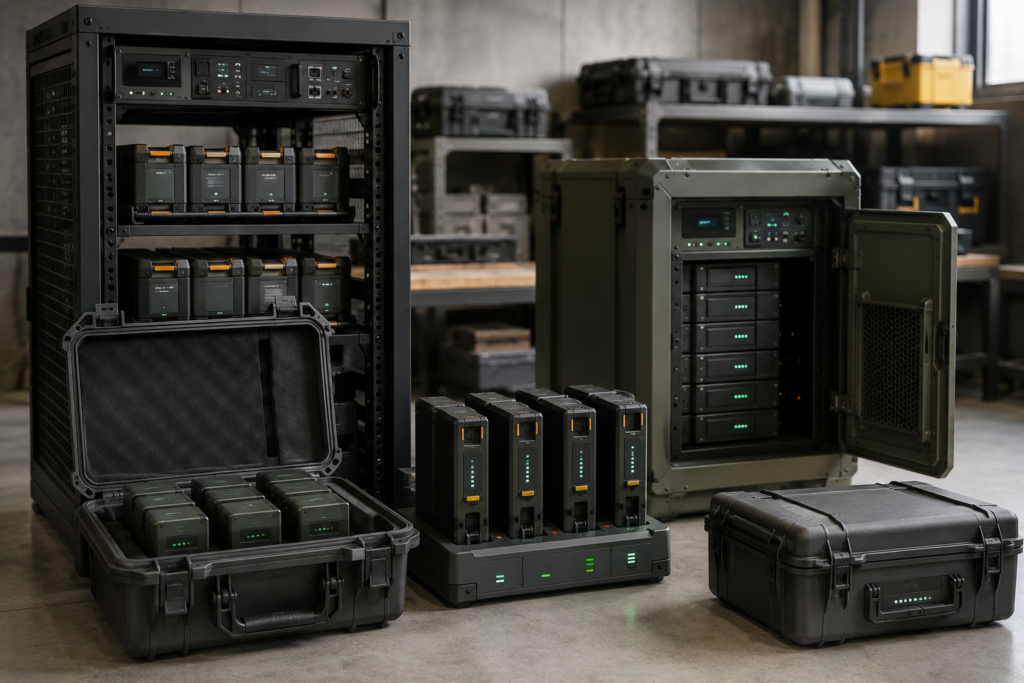
Professional Battery Systems provide scalable energy storage, charging and power-management solutions for mobile platforms, temporary facilities, communication equipment and fixed field installations. Modular configurations allow capacity and output to be adapted according to operating duration, load requirements and available charging sources.
Depending on the application, systems can use lithium iron phosphate, lithium-ion, lead-acid or other suitable battery technologies. Individual modules can be combined into portable packs, rack-mounted units, vehicle-integrated systems or larger stationary energy-storage installations.
Integrated battery-management systems monitor voltage, current, temperature, state of charge and battery condition. Protection functions may include overcharge, deep-discharge, overload, short-circuit, over-temperature and cell-balancing control, helping improve operational reliability and battery service life.
Battery systems can be paired with AC chargers, DC converters, solar controllers, generators and grid connections. Inverter and power-distribution modules provide suitable AC or DC output for radios, surveillance equipment, lighting, medical devices, workstations and other field loads.
Typical products and features include:
- Portable and modular battery packs
- Rack-mounted energy-storage systems
- Vehicle-integrated battery solutions
- Fixed-site backup battery systems
- Lithium iron phosphate and lithium-ion options
- Lead-acid battery configurations
- Intelligent battery-management systems
- State-of-charge and health monitoring
- Cell balancing and thermal protection
- AC and DC charging equipment
- Inverters and DC power converters
- Solar and generator charging compatibility
- Hot-swappable and expandable modules
- Remote monitoring and system diagnostics
- Rugged transport and protective enclosures
Battery-system solutions can be configured according to required energy capacity, continuous and peak load, voltage, runtime, charging method, weight and operating environment. Electrical protection, thermal management, transport classification, enclosure rating and applicable battery-safety certifications should be verified for the intended market. Installation, storage and disposal must follow manufacturer instructions and local electrical and environmental regulations.