

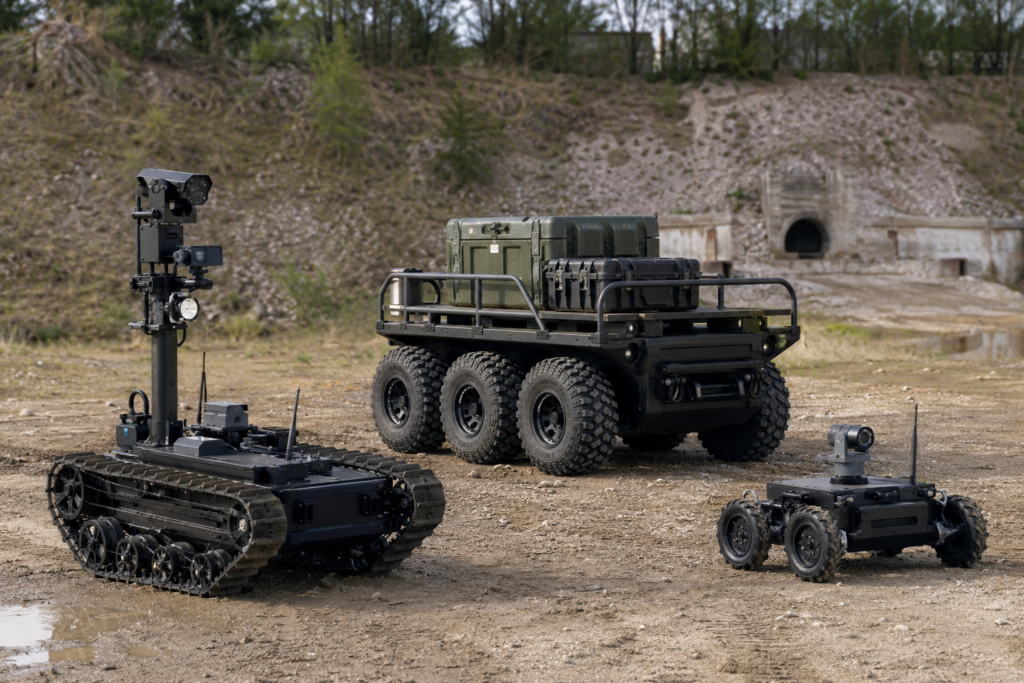
Professional Unmanned Ground Vehicles (UGVs) are remotely controlled or autonomous mobile platforms designed to support inspection, monitoring, logistics and equipment transportation in hazardous, remote or difficult-to-access environments. By reducing the need for personnel to enter high-risk areas, they can improve operational safety and expand access across complex terrain and confined spaces.
Depending on mission requirements, UGVs can use wheeled, tracked or hybrid mobility systems. Compact platforms can operate inside buildings, tunnels and industrial facilities, while larger all-terrain vehicles can transport equipment and supplies across mud, sand, gravel, slopes and other demanding surfaces.
Modular payload interfaces allow the integration of visible-light and thermal cameras, LiDAR, gas detectors, environmental sensors, robotic arms, communication relays and cargo modules. Real-time video, telemetry and sensor information can be transmitted to a portable controller, vehicle workstation or remote command centre.
Advanced configurations may support waypoint navigation, obstacle detection, route planning, automatic return, convoy operation and remote fleet management. Communication options can include radio-frequency links, cellular networks, mesh networking and other mission-appropriate data systems.
Typical capabilities and configurations include:
- Remote and autonomous operation
- Wheeled, tracked and hybrid mobility platforms
- Indoor, outdoor and all-terrain configurations
- Real-time video and telemetry transmission
- Daylight and thermal imaging
- LiDAR and obstacle-detection systems
- Gas and environmental sensing
- Robotic-arm and manipulator integration
- Cargo and equipment transportation
- Waypoint navigation and route planning
- Automatic return and safety-stop functions
- Portable and vehicle-based control stations
- Multi-vehicle networking and fleet management
- Communication-relay payloads
- Customized mission and equipment modules
UGV solutions can be configured according to terrain, payload, operating range, endurance, communication environment and required level of autonomy. Safety functions, wireless-frequency compliance, environmental protection, cybersecurity and applicable machinery or vehicle standards should be verified for the intended market and application.