

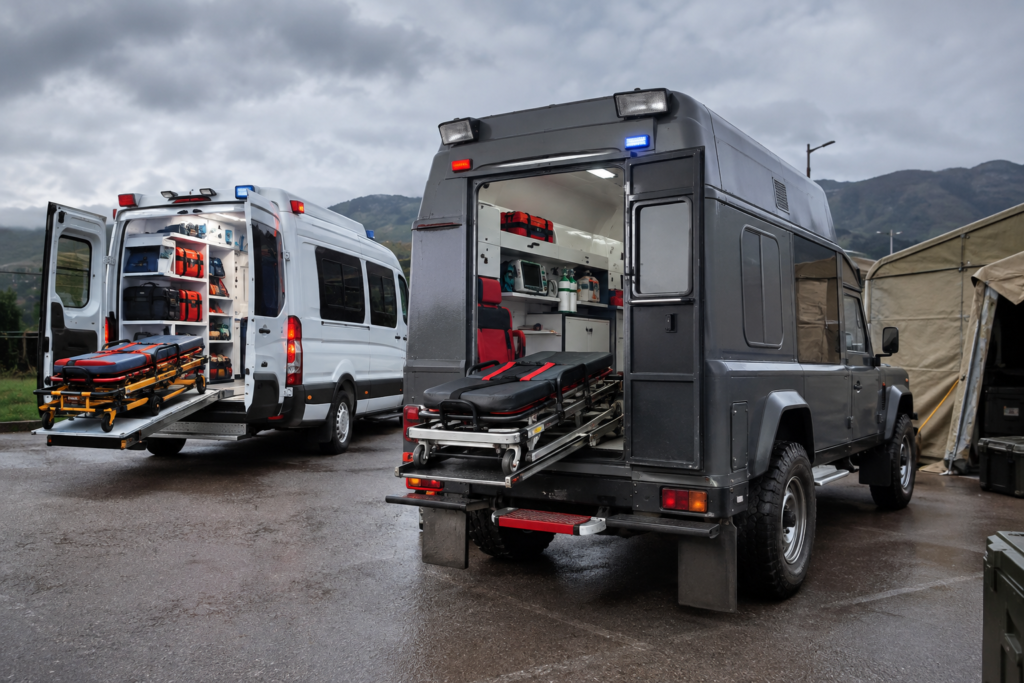
Professional Ambulances provide safe patient transportation and an organized clinical environment for emergency treatment, monitoring and pre-hospital medical care. Available in road, four-wheel-drive and off-road configurations, they can support urban emergency services, interfacility transfer, remote-area response and challenging terrain.
Depending on the required service level, ambulances can be configured for basic life support, advanced life support, patient transfer, intensive-care transport or specialized applications. Vehicle platforms may include vans, box-body vehicles, trucks or all-terrain chassis selected according to patient capacity, road conditions and equipment requirements.
The patient compartment can integrate a wheeled stretcher and loading system, medical oxygen, suction equipment, patient monitoring, defibrillation, ventilation and infusion devices. Secure cabinets, treatment surfaces, medical lighting and ergonomic seating help clinical personnel access equipment and care for the patient during transport.
Heating, ventilation, air conditioning, interior lighting, communications and vehicle power systems support continuous operation. Surfaces and materials can be selected for durability, cleaning and infection control, while warning lights, sirens and exterior markings can be configured according to local requirements.
Typical configurations and capabilities include:
- Basic life-support ambulances
- Advanced life-support ambulances
- Patient-transfer vehicles
- Intensive-care transport ambulances
- Four-wheel-drive and off-road ambulances
- Adult, paediatric and neonatal transport options
- Wheeled stretchers and loading systems
- Medical oxygen and suction systems
- Patient monitors and defibrillators
- Transport ventilators and infusion equipment
- Secure medical storage and treatment surfaces
- Interior and external scene lighting
- Radio, cellular and data communications
- Independent and backup electrical systems
- Heating, ventilation and air conditioning
Ambulance solutions can be customized according to chassis type, clinical service level, patient group, crew size, terrain and local emergency-service requirements. Vehicle homologation, patient-compartment design, stretcher retention, medical-gas installation, electrical safety and medical-device registration should be verified for the intended market. Clinical configuration and operation must involve appropriately qualified healthcare and technical professionals.