

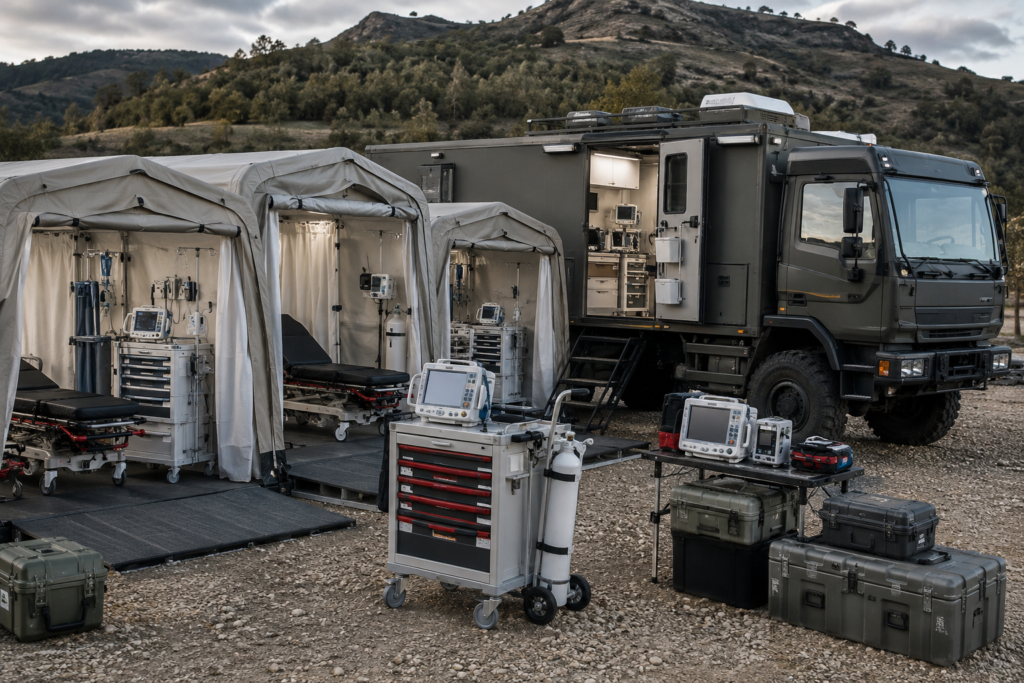
Deployable Mobile Medical Systems integrate treatment areas, diagnostic equipment, utilities and clinical support infrastructure into rapidly deployable vehicles, trailers, containers, shelters or modular field facilities. These systems enable healthcare services to be established quickly in remote locations, disaster areas, temporary sites and regions with limited permanent medical infrastructure.
Depending on clinical requirements, mobile systems can be configured as primary-care clinics, emergency treatment units, diagnostic centres, laboratories, imaging units, operating rooms, intensive-care units, isolation facilities or complete modular field hospitals. Internal layouts are designed to support efficient patient flow, infection control, staff movement and safe equipment operation.
Medical equipment packages may include patient monitors, portable ultrasound, digital radiography, laboratory analysers, oxygen systems, ventilators, defibrillators, suction units and sterilization equipment. Examination furniture, medical storage, communication systems and digital patient-data platforms can also be integrated.
Independent power generation, battery backup, water supply, wastewater handling, medical-gas distribution, lighting, ventilation and environmental-control systems support operation where permanent utilities are unavailable. Satellite, cellular and radio connectivity can enable telemedicine, remote consultation and coordination with hospitals or emergency command centres.
Typical configurations and capabilities include:
- Mobile primary-care and examination clinics
- Emergency and trauma-treatment units
- Mobile diagnostic imaging systems
- Mobile laboratory and testing facilities
- Mobile operating and procedure rooms
- Intensive-care and patient-observation units
- Isolation and infection-control facilities
- Dental, ophthalmic and specialist clinics
- Vehicle, trailer, container and shelter configurations
- Integrated medical equipment and furniture
- Independent power and battery-backup systems
- Water, sanitation and medical-gas infrastructure
- Heating, cooling and ventilation systems
- Telemedicine and patient-data connectivity
- Modular expansion and multi-unit networking
Mobile medical systems can be customized according to clinical services, patient capacity, deployment duration, transportation method, climate and available infrastructure. Medical-device registration, facility design, infection-control requirements, utility safety and vehicle or structural compliance should be verified for the intended market. Clinical planning and operation must involve appropriately qualified healthcare and technical professionals.