

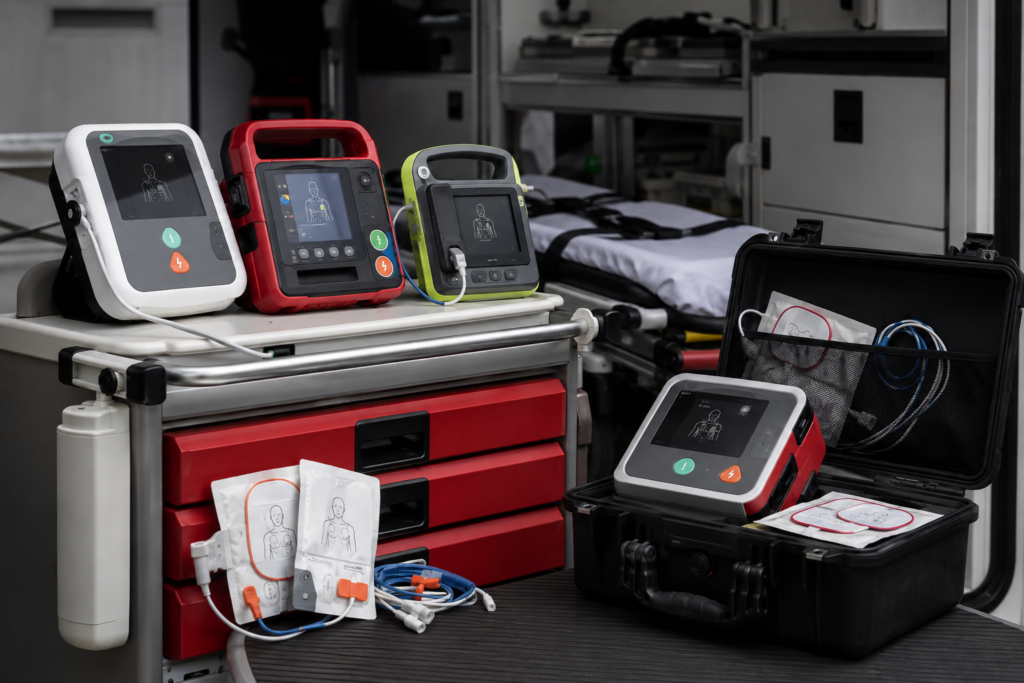
Portable Automated External Defibrillators (AEDs) and professional defibrillators provide rapid response capabilities for patients experiencing sudden cardiac arrest and other shockable cardiac emergencies. Designed for public-access, pre-hospital and clinical environments, these devices deliver guided assessment and controlled electrical therapy according to the selected model and intended user group.
AEDs automatically analyse the patient’s heart rhythm and provide clear visual and voice instructions throughout the rescue process. Semi-automatic models prompt the responder to deliver a shock when advised, while fully automatic models can deliver therapy without requiring the user to press a shock button, subject to local regulations and product configuration.
Professional defibrillators may combine manual defibrillation, synchronized cardioversion, ECG monitoring and optional external pacing within a single portable platform. Advanced configurations can also support SpO₂, non-invasive blood pressure, EtCO₂ and other patient-monitoring parameters for trained medical personnel.
Rugged housings, high-visibility displays, rechargeable or long-life batteries and event-recording functions support use in ambulances, emergency vehicles, hospitals, workplaces and public facilities. Paediatric operation may be provided through dedicated electrodes, selectable energy settings or child-mode functions.
Typical capabilities include:
- Automatic heart-rhythm analysis
- Semi-automatic and fully automatic AED options
- Clear visual and voice instructions
- Manual defibrillation options
- Synchronized cardioversion
- Optional external pacing
- ECG display and monitoring
- Adult and paediatric operating modes
- Configurable energy delivery
- CPR guidance and metronome options
- Visual and audible status indicators
- Self-testing and readiness monitoring
- Rescue-event recording and data export
- Rechargeable or long-life battery options
- Portable, wall-mounted and vehicle-based configurations
AED and defibrillator solutions should be selected according to the intended users, clinical environment, patient groups and local resuscitation protocols. Medical-device registration, electrical safety, waveform performance, battery readiness and electrode expiry dates must be verified for the intended market. Professional functions should only be operated by appropriately trained and authorized personnel.