

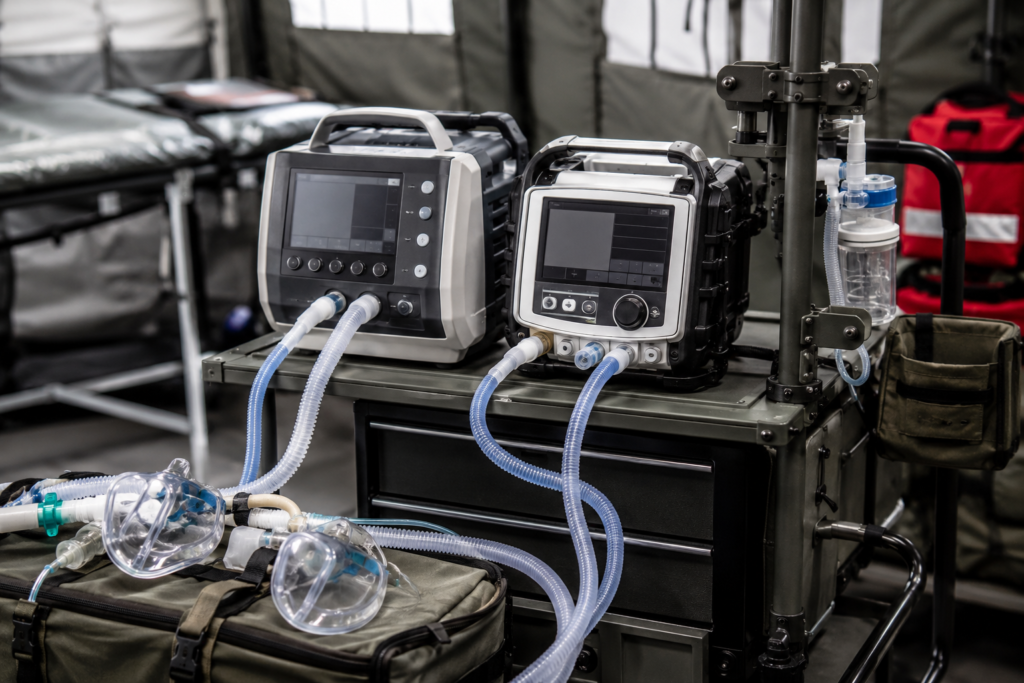
Portable Ventilators are compact respiratory-support devices designed for emergency care, ambulance transport, interfacility transfer and mobile medical facilities. Lightweight construction, independent power options and transport-ready mounting systems allow qualified medical personnel to provide controlled ventilation outside conventional intensive-care environments.
Depending on the model and intended clinical use, portable ventilators may support invasive and non-invasive ventilation for adult, paediatric and selected neonatal patients. Available ventilation modes can include volume-controlled, pressure-controlled, assisted, spontaneous and continuous positive airway pressure configurations.
Integrated displays provide real-time information on airway pressure, respiratory rate, tidal volume, oxygen concentration and other relevant parameters. Configurable visual and audible alarms can notify clinicians of conditions such as high or low pressure, disconnection, apnea, low battery and gas-supply interruption.
Portable ventilators may operate using compressed oxygen, turbine-driven airflow or combined pneumatic and electronic systems. Rechargeable batteries, vehicle-power adapters, external power supplies and oxygen-cylinder connections support use during transport and extended field deployment.
Typical capabilities include:
- Invasive and non-invasive ventilation
- Adult, paediatric and neonatal configuration options
- Volume- and pressure-controlled ventilation modes
- Assisted and spontaneous breathing support
- CPAP and pressure-support options
- Adjustable oxygen concentration
- Real-time respiratory parameter display
- Configurable visual and audible alarms
- Integrated turbine or pneumatic operation
- Internal rechargeable battery
- Vehicle and external power compatibility
- Oxygen-cylinder and central-gas connections
- Patient-circuit and filtration accessories
- Ambulance, stretcher and stand mounting options
- Compact, rugged and transport-ready construction
Portable ventilator solutions can be configured according to patient group, required ventilation modes, oxygen availability, battery duration and transport environment. Medical-device registration, ventilation accuracy, alarm performance, electrical safety and transport certification should be verified for the intended market. Selection, setup and operation must be performed by appropriately trained and authorized healthcare personnel.