

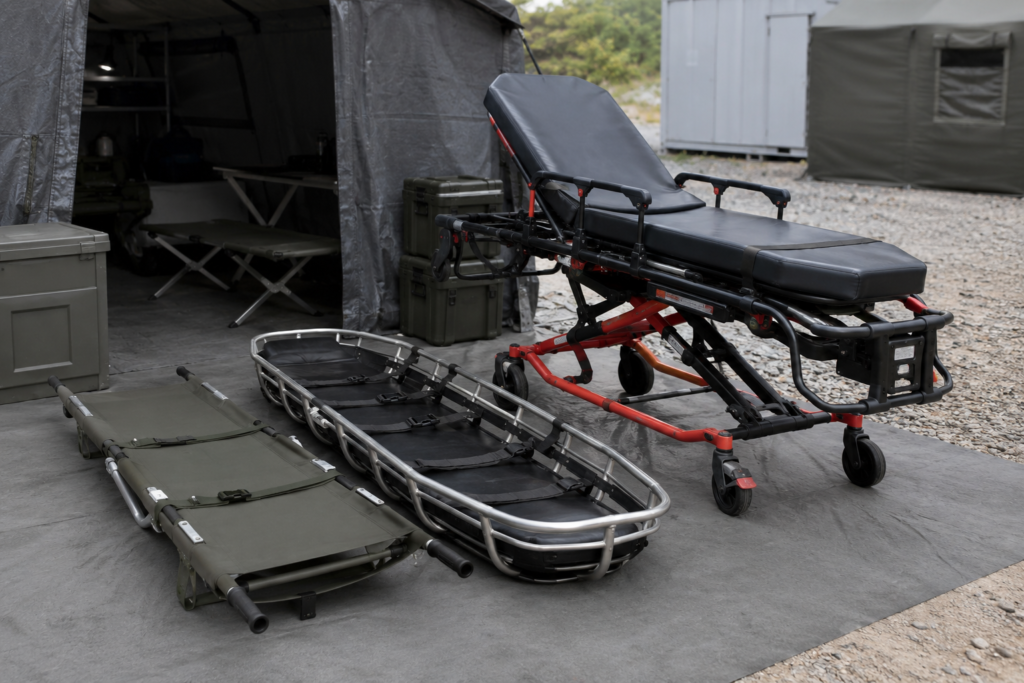
Professional Stretchers provide safe, stable and efficient patient transport for emergency response, field medicine, rescue operations and ambulance services. Available in folding, basket, scoop, wheeled and other specialized configurations, they support patient movement across hospitals, vehicles, confined spaces, uneven terrain and remote locations.
Folding stretchers offer compact storage and rapid deployment for field teams and temporary medical facilities. Basket stretchers provide a protective structure for rescue and evacuation across difficult terrain, while scoop stretchers allow trained responders to position the device around a patient with limited unnecessary movement. Wheeled ambulance stretchers support efficient loading, unloading and transport between emergency scenes, vehicles and medical facilities.
Depending on the model, stretchers can incorporate adjustable backrests, folding handles, restraint straps, mattress pads, IV-pole mounts and height-adjustable frames. Lightweight aluminium alloys, reinforced polymers and durable fabrics provide a balance of strength, portability and ease of cleaning.
Selected configurations may support stair evacuation, vertical or horizontal lifting, confined-space rescue and compatibility with ambulance locking systems. Carrying bags, protective covers and mounting brackets can also be supplied.
Typical products and features include:
- Folding field stretchers
- Basket and rescue stretchers
- Scoop stretchers
- Wheeled ambulance stretchers
- Stair and evacuation chairs
- Flexible and roll-up stretchers
- Adjustable backrests and frame heights
- Patient-restraint straps
- Padded and easy-clean surfaces
- Lightweight, high-strength construction
- Foldable handles and compact storage
- Lifting-point and rope-system compatibility
- IV-pole and accessory mounting options
- Ambulance locking and loading systems
- Adult, paediatric and bariatric configurations
Stretcher solutions should be selected according to patient capacity, transport environment, vehicle compatibility and responder procedures. Load ratings, restraint systems and applicable medical-device or rescue standards should be verified before procurement. Patient lifting, securing and transport should be performed only by appropriately trained personnel.