

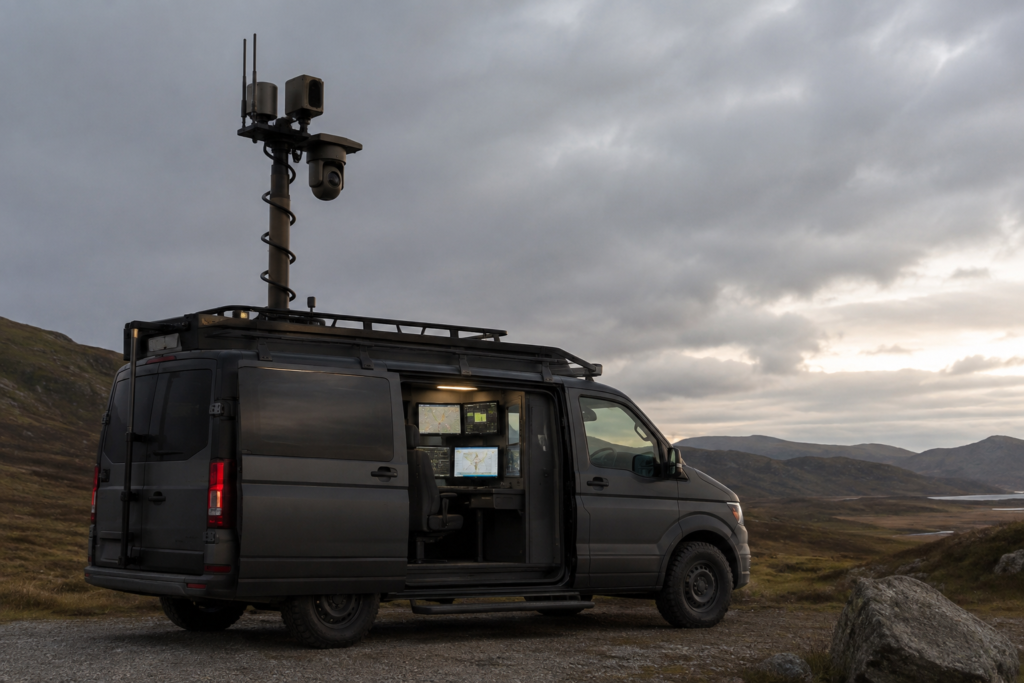
Multi-Sensor Detection Systems integrate radio-frequency detection, low-altitude radar and electro-optical/infrared tracking technologies into a unified airspace-monitoring solution. By combining the strengths of complementary sensors, these systems improve detection reliability, target classification, visual verification and overall situational awareness.
RF sensors provide passive early warning by detecting communication signals between UAVs and their controllers. Radar systems monitor low-altitude airspace and track small aerial targets, including autonomous or radio-silent UAVs. EO/IR equipment provides day-and-night visual confirmation, allowing operators to verify detected objects and continuously observe their behavior.
Data from all sensors is collected, correlated and displayed through an integrated command-and-control platform. When a potential target is detected, the system can compare information from multiple sources, estimate its position and trajectory, automatically direct EO/IR equipment toward the target and generate real-time alerts. This layered approach helps reduce blind spots and false alarms while improving tracking continuity.
Typical capabilities include:
- Integrated RF, radar and EO/IR detection
- Passive and active airspace monitoring
- Detection of controlled and autonomous UAVs
- Multi-source data correlation and sensor fusion
- Real-time target positioning and trajectory tracking
- Automatic sensor cueing and visual verification
- Day-and-night target identification
- Multi-target detection and tracking
- Target classification and false-alarm reduction
- Configurable warning zones and alarm rules
- Event recording, playback and data analysis
- Multi-site and multi-node networking
- Fixed-site, portable and vehicle-mounted configurations
- Integration with existing security and command platforms
Multi-sensor detection solutions can be customized according to the protected area, terrain, surrounding structures, required detection range, deployment method and threat profile. They are suitable for airports, borders, ports, critical infrastructure, industrial facilities, government sites, correctional facilities, major events and other sensitive locations requiring comprehensive and reliable airspace awareness.