
Fixed-Site Drone Detection Systems are permanently installed solutions designed to provide continuous, long-term monitoring and early warning against unauthorized or potentially hazardous UAV activity. They are suitable for airports, critical infrastructure, industrial facilities, government sites and other sensitive locations requiring reliable airspace protection.
Depending on operational requirements, fixed installations can combine RF detectors, low-altitude radar, EO/IR tracking equipment and other sensors within an integrated detection network. This layered architecture enables the system to detect signal-controlled and autonomous UAVs, estimate their position, track flight paths and provide visual confirmation during both daytime and nighttime operations.
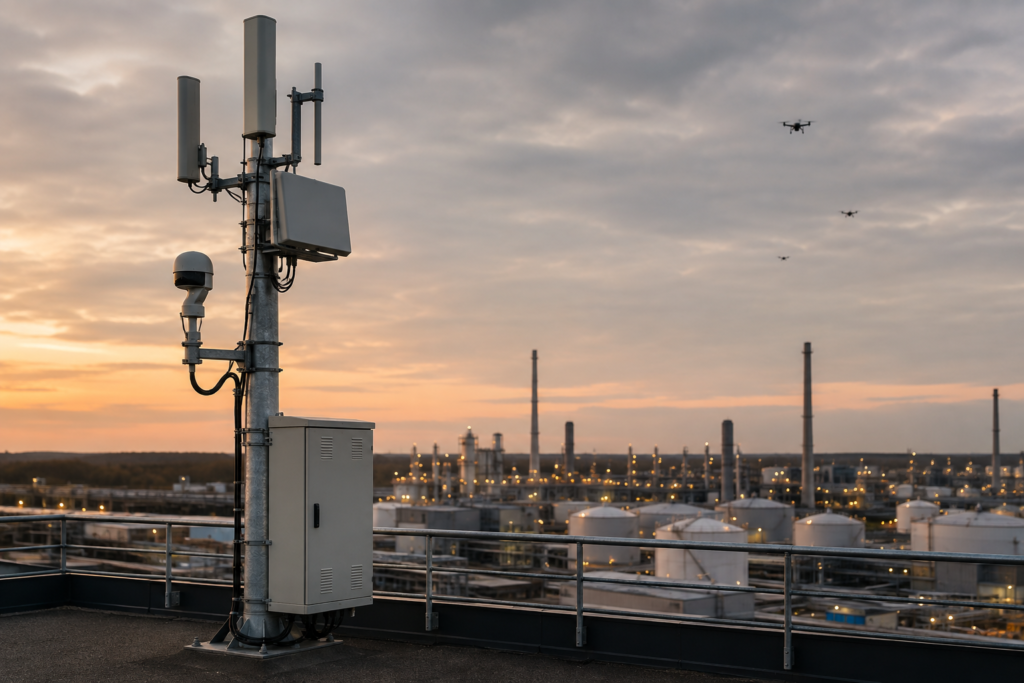
Sensors can be installed on rooftops, towers, perimeter structures or dedicated monitoring points to provide wide-area or sector-based coverage. Multiple detection nodes can be networked to reduce blind spots and protect large or complex locations. When a target is detected, the system can automatically generate alerts, display its position and trajectory, cue EO/IR equipment for visual verification and record relevant mission data.
Typical capabilities include:
- Continuous 24/7 airspace monitoring
- Early warning of unauthorized UAV activity
- Detection of signal-controlled and autonomous UAVs
- Multi-sensor RF, radar and EO/IR integration
- Real-time target positioning and trajectory tracking
- Detection and tracking of multiple aerial targets
- Automatic sensor cueing and visual confirmation
- Target classification and false-alarm reduction
- Configurable alarm zones and response rules
- Event recording, playback and data analysis
- Multi-site networking and centralized management
- Weather-resistant outdoor sensor installations
- Integration with existing security infrastructure
- Connection to counter-UAS command-and-control platforms
Fixed-site drone detection solutions can be customized according to site size, terrain, surrounding buildings, required detection range, threat profile and existing security architecture. They support continuous airspace awareness and coordinated response planning for airports, energy facilities, ports, industrial sites, government locations, correctional facilities, large venues and other protected areas.