
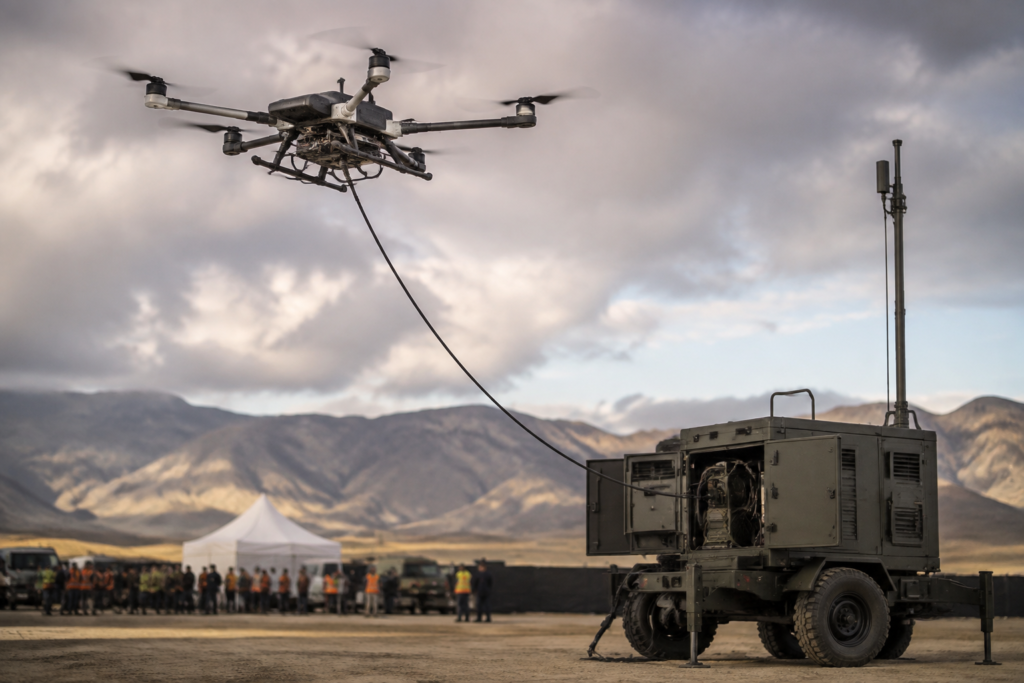
Tethered drones are unmanned aerial systems designed for persistent airborne operations using a physical tether connected to a ground-based power and control station. By receiving continuous electrical power from the ground, these platforms can remain airborne for extended periods without frequent battery replacement or recharging, making them particularly suitable for continuous monitoring and fixed-area missions.
The tether can combine power transmission with secure data communication, providing a stable connection between the UAV and ground station. Compared with conventional battery-powered drones, tethered systems offer extended operational duration, controlled operating boundaries and reliable continuous data transmission.
Tethered drones can be equipped with EO/IR cameras, thermal imaging systems, high-resolution zoom cameras, communication relay equipment, lighting systems and other specialized payloads. When deployed at an elevated position, they can provide continuous aerial observation and an expanded communication or sensor coverage area.
Ground stations can be configured for stationary, portable or vehicle-mounted deployment, allowing rapid operation in different environments.
Typical applications include:
- Persistent aerial surveillance
- Border and perimeter monitoring
- Critical infrastructure protection
- Public safety and emergency response
- Large-event and venue security
- Communication and radio relay
- Disaster-area monitoring
- Traffic and crowd monitoring
- Industrial facility surveillance
- Port and coastal monitoring
- Temporary communication coverage
- Long-duration observation missions
Available with different operating altitudes, payload capacities, tether lengths, ground power systems and sensor configurations, tethered UAV solutions can be customized for civilian, industrial, emergency-response and security applications.