
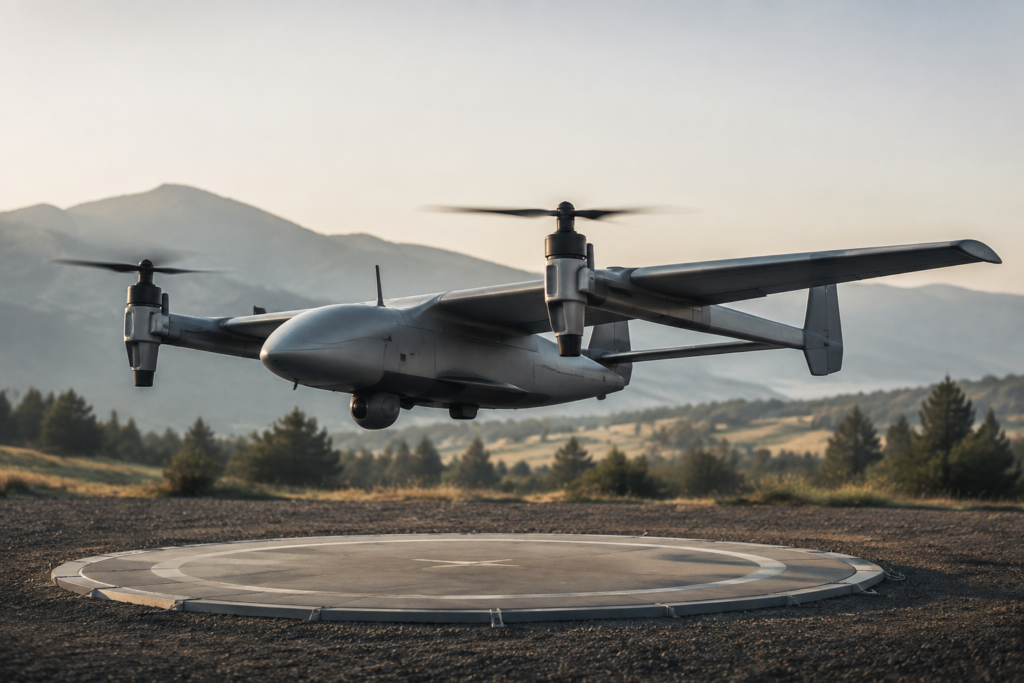
VTOL (Vertical Takeoff and Landing) UAVs combine the long-range capability, endurance and aerodynamic efficiency of fixed-wing aircraft with the operational flexibility of vertical takeoff and landing. They can be deployed without conventional runways, catapults or complex recovery systems, making them particularly suitable for remote areas, mountainous terrain, urban environments, ships and other locations where space or infrastructure is limited.
During operation, VTOL UAVs can take off vertically, transition into efficient fixed-wing forward flight for long-distance missions, and return to vertical flight for precise landing. This hybrid architecture provides greater range and endurance than conventional multi-rotor UAVs while retaining flexible deployment capabilities.
VTOL platforms can be integrated with a variety of mission payloads, including EO/IR cameras, high-resolution mapping cameras, multispectral and hyperspectral sensors, LiDAR, communication relay equipment and other specialized payloads. Advanced flight control, navigation and data-link systems support autonomous takeoff and landing, route planning, real-time monitoring and long-range mission operations.
Typical applications include:
- Border and perimeter surveillance
- Long-range reconnaissance and monitoring
- Mapping and aerial surveying
- Oil and gas pipeline inspection
- Power transmission line inspection
- Critical infrastructure monitoring
- Maritime and coastal surveillance
- Search and rescue operations
- Emergency response and disaster assessment
- Environmental and wildlife monitoring
- Communication relay
- Remote-area inspection and specialized missions
Available in different airframe sizes, endurance levels, payload capacities and communication configurations, VTOL UAV systems can be customized according to specific operational environments and mission requirements.